

Why Does My Cat Want Attention When I'm Working?
Quick answer
Why does my cat want attention the moment I sit down to work? In most cases, your cat isn't being difficult. They want to be near you, and your keyboard is where your attention is.
The fix owners report most often is simple. Give your cat a comfy spot of their own beside you, and reward them for using it.
Key takeaways
- It's about closeness, not mischief. Cats who sit on keyboards are usually after attention, warmth, or just being near you.
- A spot of their own beats shooing them away. A bed, box, or chair beside you lets your cat feel included. Reward them every time they use it.
- Sudden clinginess deserves a vet visit. If the demanding behavior is new, or comes with other changes, rule out a medical cause first.
⚠ When it's more than wanting attention
Everyday desk crashing builds slowly and looks the same from day to day. Call your vet if your cat's clinginess is sudden, or comes with any of these:
- Litter box changes: straining, peeing small amounts often, peeing outside the box, or blood in the urine.
- Changes in eating or energy: eating less, hiding, or losing interest in play.
- New vocalizing or restlessness: crying, pacing, or following you everywhere.
VCA Animal Hospitals notes that keyboard surfing plus other new behaviors can signal anxiety. VCA recommends a vet visit to rule out a medical cause.
Go to your vet or an emergency clinic right away if your cat strains in the litter box and passes little or no urine. A urinary blockage is an emergency, especially in male cats, according to the American College of Veterinary Surgeons.
Why does my cat want attention when I work?
To your cat, the desk is where the action is. You sit still for hours, staring at a screen, while your hands keep moving. Planting themselves in the middle of it is the fastest way to get noticed.
Behavior experts mostly point to attention. Feline behavior specialist Marci Koski told Kinship that cats see you focusing on something and want some of that focus too. Keyboards and laptops are also warm, and they sit right in front of you, as PetMD explains.
There's a deeper reason too. The AAFP and ISFM feline environmental needs guidelines list positive, predictable contact with people as one of five core needs for a healthy cat. The guidelines also note that many cats like frequent, low-key contact they can start and end on their own terms. A spot beside your desk offers exactly that.

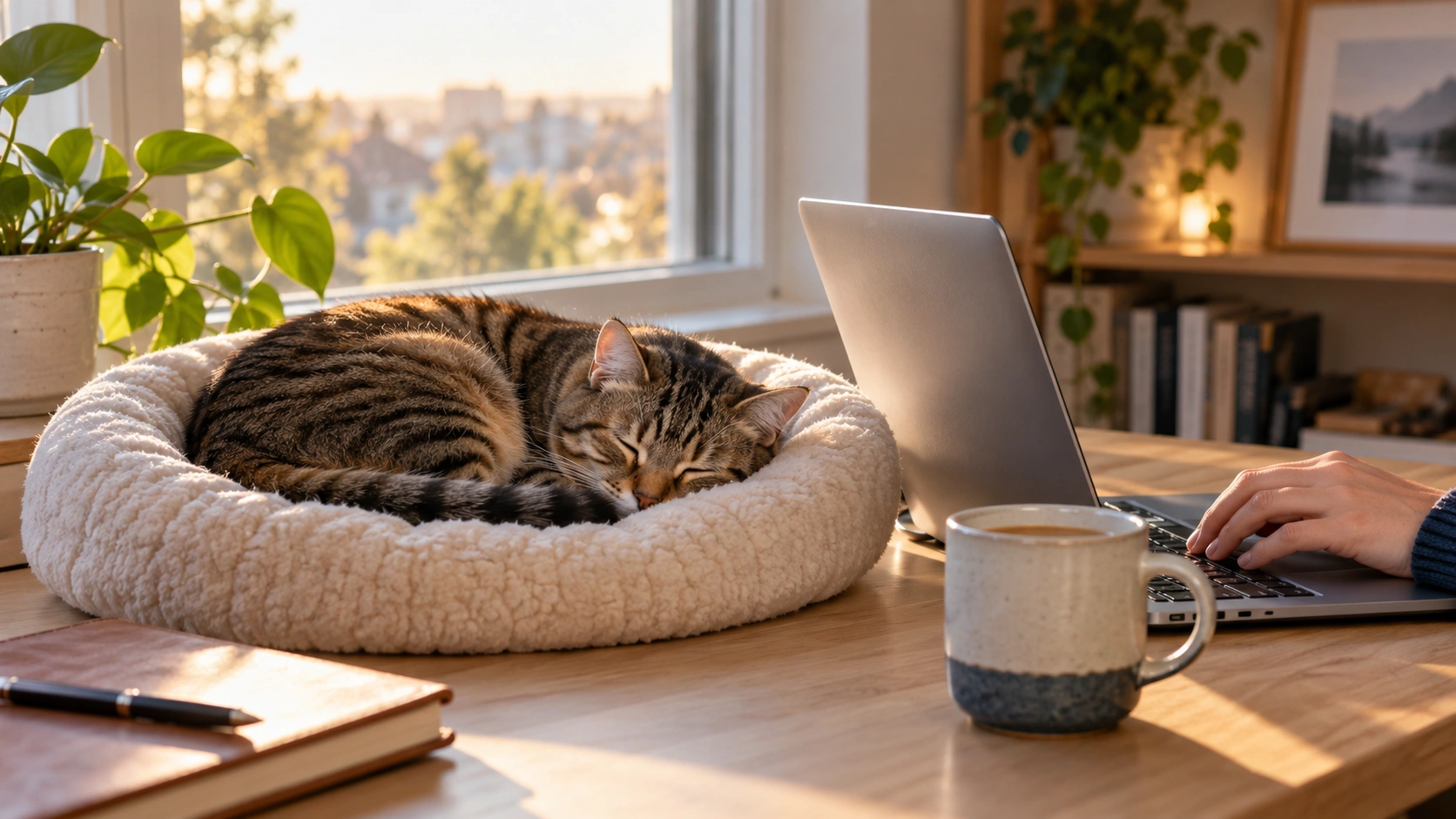
Owners see the same pattern. In one popular Reddit thread with more than 4,000 upvotes, an owner described weeks of meowing and nipping at her desk. She moved her cat's bed onto the desk, and the cat settled almost right away. Dozens of commenters shared their own versions of the same fix.
Is it okay to let my cat on my desk?
Yes, if you're happy with it. The real trouble spots are the keyboard, loose cables, and warm laptop vents, not the desk itself.
Pick a house rule and stick to it, because cats learn from consistency. If you have a kitten, set the rule early. As several owners point out, habits you allow now are harder to undo later.
How do I give my cat a spot at my desk?
Owners in the thread used four main setups. Here's how they compare.
| Option | Cost | Space needed | Good fit for | The catch |
|---|---|---|---|---|
| Bed, box, or blanket on the desk | Free to low | A corner of the desk | Most cats; desks with some spare room | Takes up desk space |
| A chair beside yours | Free if you have a spare | Floor space next to you | Cats who like to be at your elbow; standing desks | Your cat may still steal your chair |
| Clamp-on desk bed | Mid to high | A few inches of desk edge | Small desks; big monitors; cats who want eye level | Must fit your desk, and can fall if poorly fitted |
| Window perch near the desk | Low to mid | A nearby window | Cats who love bird-watching | Only works if your desk is by a window |
Start with what you already have
You don't need to buy anything to test the idea. Owners in the thread used cardboard boxes, a folded blanket, an old tray, and the cat's existing bed. Put it within arm's reach, so you can give a quick scratch without leaving your work.
Give your cat a chair of their own
A spare chair next to yours was the most common setup in the thread. It keeps your desk clear and puts your cat right at your side.
Several owners shared a smart rule: they only pet their cat when the cat is in the chair, never on the desk. That turns the chair into the place where good things happen.

Short on space? Try a clamp-on desk bed
A clamp-on desk bed is a small cat bed on an arm that clamps to the edge of your desk. It works like a monitor arm, so it uses very little desk surface. Owners with small desks or wide monitors were the biggest fans.

Consider it if
- Your desk has no spare surface
- Your desk edge is solid and fits the clamp
- Your cat likes to be up high, at your eye level
Skip it if
- Your desk is glass or has a thin or hollow edge
- Your cat is near or over the bed's weight rating
- You have two cats and room for only one bed
Desk by a window? Add a perch
If your desk sits near a window, a window perch gives your cat two shows at once: you and the birds outside. Owners who use them like that the perch costs no desk space at all.
How do I stop my cat walking on my keyboard?
A new spot works best when you pair it with a few habits. Here's a routine you can start today.
- Set up the spot before you sit down. Place it on the side your cat usually approaches from, within easy reach.
- Make it the best seat in the room. Add soft bedding and a worn T-shirt that smells like you.
- Play first, then work. A short play session before you start takes the edge off. PetMD suggests regular play and enrichment to head off attention-seeking.
- Reward the spot, not the keyboard. Pet and praise your cat when they settle in their spot. If they climb onto the keyboard, calmly lift them back without fuss or cuddles.
- Never punish. Behavior experts agree that your cat isn't being bad; they just want you. Scolding doesn't address the reason they're there.
- Protect the keyboard. Some owners slide the keyboard under a monitor stand between tasks. Others set out an old, unplugged keyboard as a decoy.
- Build in regular breaks. A quick cuddle or play break at similar times each day gives your cat something to count on.
What if my cat ignores the new spot?
Give it a week or two. Many cats check out a new spot for days before they claim it.
- Move it closer. Your cat wants to be near you, so a few inches can make the difference.
- Try a different height. Some cats want to be level with your face; others prefer your lap height.
- Make it smell like home. A blanket from their favorite nap spot often helps.
- Give each cat a spot. In multi-cat homes, owners report fights over a single bed. One spot per cat keeps the peace.
If your cat pees in or near the new bed, call your vet. Research from Ohio State found stress alone can cause peeing outside the litter box. Still, a medical cause needs to be ruled out first.
How do I choose a clamp-on desk bed safely?
Clamp-on beds are only as safe as their fit. One Chewy reviewer said her desk bed fell when her cat jumped in, even though she checked the clamp often. Run through this list before you buy, and again after you install.
- Measure your desk edge. Compare its thickness to the clamp range in the listing.
- Check the edge itself. Clamp to a solid edge only. Skip glass tops and thin or hollow edges.
- Weigh your cat. Leave a margin under the weight rating. Ratings vary widely, sometimes even between listings for the same model.
- Look at where the arm meets the bed. One owner of a 17 lb cat recommends an arm that connects to the center of the bed, not the edge.
- Line up the bed with the clamp. A GamingTrend review warns that a bed pulling against its clamp can fall when a cat hops in.
- Re-check the clamp every week. Cats jump in and out all day, and clamps can loosen over time.
- Test it on a standing desk. Raise and lower the desk to make sure the bed clears everything.
- Choose a washable cover. Your cat will spend hours in it, so easy cleaning matters.
Frequently asked questions
Why does my cat sit on my keyboard?
Mostly for attention, warmth, and closeness. The keyboard sits between you and the thing you're focused on, so it's the quickest way to get noticed. A spot of their own nearby usually helps.
Do cat desk beds actually work?
Many owners say yes, but not every cat takes to one. Test the idea first with a free box or blanket on your desk. If your cat loves it, a clamp-on bed can free up the space.
Can a cat desk bed hold a large cat like a Maine Coon?
It depends on the model. Weight ratings vary widely; the Desk Nest, for example, is rated for cats up to 25 lb. Weigh your cat, leave a margin, and choose an arm that supports the center of the bed.
Why does my cat meow when I'm on calls?
Calls are another moment when your attention is clearly somewhere else. A short play session before long meetings and a spot within reach can help. Some owners simply hold their cat during calls when their hands are free.
Why is my cat suddenly so clingy?
A sudden change in behavior can have a medical cause, including pain or illness. Book a vet visit, especially if you notice other changes like litter box problems or eating less. Stress from changes at home can play a part too.
Sources
- VCA Animal Hospitals: Working from home? Why your cat loves your keyboard
- American Association of Feline Practitioners: AAFP/ISFM Environmental Needs Guidelines
- American College of Veterinary Surgeons: Urinary obstruction in male cats
- PetMD: Is your cat sick or stressed out? (on the Ohio State JAVMA study)
- PetMD: Cats on keyboards, why they love them
- Kinship: The real reason your cat interrupts your Zoom meetings
- Chewy: Owner reviews of a clamp-on cat desk bed
- GamingTrend: Desk Nest review
- Reddit: owner discussion thread on making space for cats at the desk (October 2026)
This article is for general information and isn't a substitute for advice from your veterinarian.